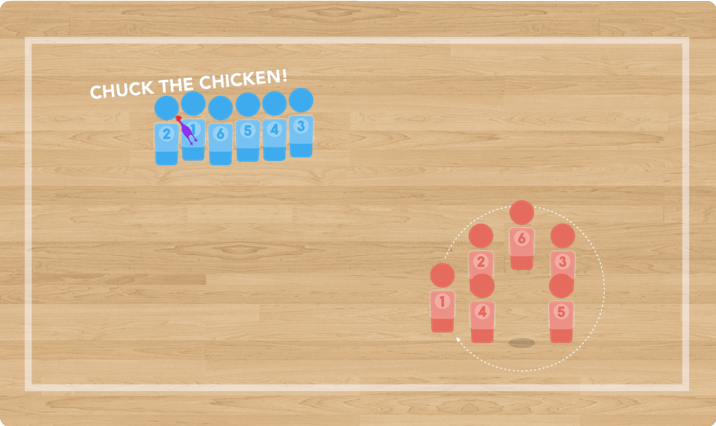
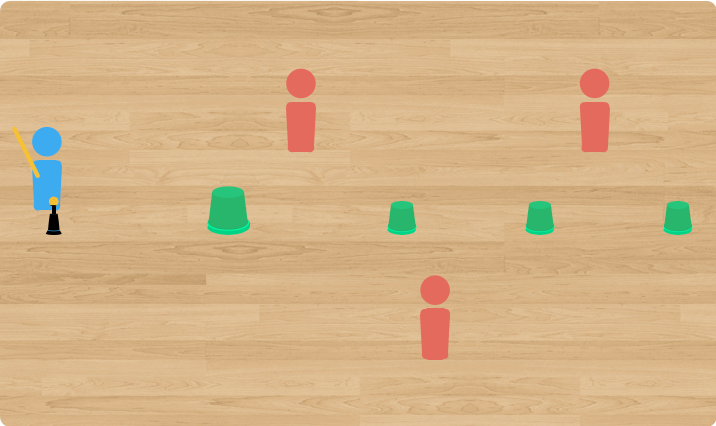
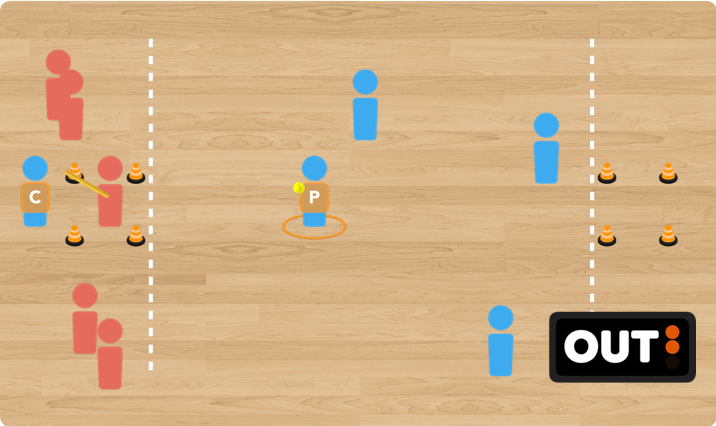
Chuck The Chicken is a striking and fielding game in which teams race to score laps while their opponents field a rubber chicken. Students learn to identify open space and send the object there to create scoring opportunities for their team.
Running players should be mindful of any tennis balls on the ground as they run.
Players should avoid throwing the chicken at the other team.
Running players should avoid making contact with their teammates as they try to score points.
Hand this to a sub and walk away. Printable pages for every build, diagrams, discussion questions, teacher notes, and assessment ideas. All in one ready-to-print package so there's no sub plan to write.
#PhysEdU Plus includes instant access to every printable game sheet in ThePhysicalEducator.com's games database. $49 a year.
Builds allow you to increase the game's complexity, one layer at a time.
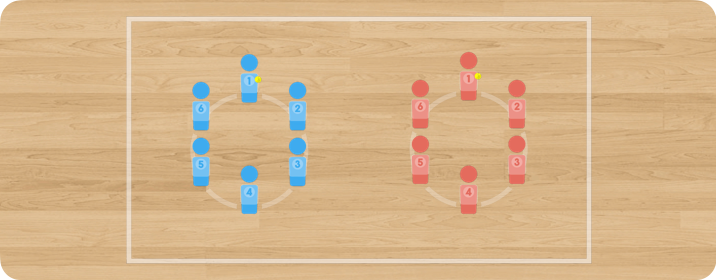
The teacher divides the class into two numbered teams. Teams begin this build by getting into a circle formation. The teacher gives an egg (tennis ball) to each team's player one.
On the teacher's signal, each team's player one sprints around their team's circle attempting to get back to their starting spot as fast as possible. Once they do so, they toss the ball to player two who does the same.
The objective of this build is to have every player on your team complete their lap before the other team does the same.
This build introduces the circle formation and running for points mechanic without the complexity of tactical decision making.
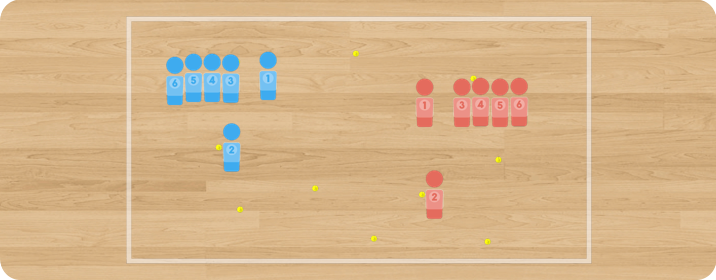
The teacher scatters eggs (tennis balls) throughout the playing area.
On the teacher's signal, each team's player one runs to an egg and holds it in the air. Their team then lines up in order behind them. Once a team is lined up, they try to get the egg to the back of the line by passing it in an over and under pattern.
When the player at the back of the line gets the egg, that player yells "GOT IT" and holds onto that egg until the end of the round. Once player two hears "GOT IT" called, they run to a new egg and the process begins again.
The first team to have each member holding an egg wins the round.
This build isolates the defensive fielding mechanics. Emphasize speed in lining up and passing accurately. Students should understand this represents the defensive role of stopping scoring.
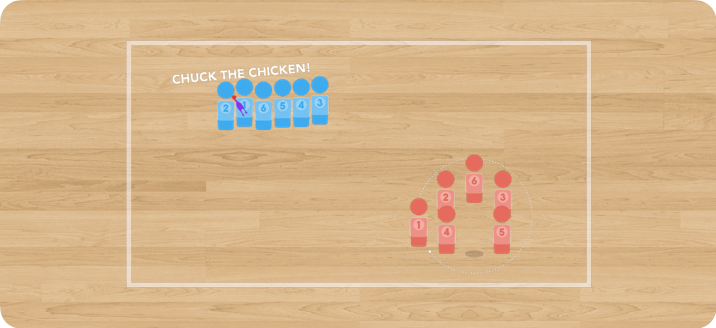
Teams begin in circle formations in the playing area. One team starts as the running team, the other team starts as the fielding team. A player on the running team is given a chicken.
Once the teacher signals they may start, the player in possession of the chicken calls "CHUCK THE CHICKEN" and throws it into the playing area. As soon as they do, that player begins to run around their team's circle. Each time they make it around the circle, they score a point for their team, which their teammates count out loud.
To stop the running team from scoring a large number of points, the fielding team must field the chicken. Just as they did in build two, player one on the fielding team runs towards the chicken. Once that player has the chicken in their hand, they hold it up high for their teammates to see. Their team must line up, in order, behind them and begin to pass the chicken over and under to the back of the line.
Once the chicken reaches the last player in the line, that player calls "CHUCK THE CHICKEN" and throws the chicken towards an open space. As soon as the chicken has been thrown, the teams automatically switch roles.
Every time a team regains the role of running team, the next player in the team's order gets to be the runner. Once every player on each team has had a turn to run, the points are tallied up and the team with the highest score wins.
Print the game sheet, leave it on your desk, and your sub has everything they need: the diagrams, the builds in order, what to say, and what to watch for. This one is $4. #PhysEdU Plus members get all 39, free forever, for $49 a year.
Games that build on the same tactics.